+38 044 379-12-05, (-07)
+38 044 379-12-05, (-07)
What is the optimal ventilation system for an industrial and commercial kitchen?
A local exhaust system or a ventilation system for the entire area of the premises? What types of exhaust hoods or ventilated and air-conditioned ceilings should be used?
They are chosen depending on the type and size of the kitchen, the location of the equipment and the amount of capital investment. Design and architecture should not be neglected in open kitchens.
There are two main options for ventilation systems for kitchens:
Local systems - air removal is carried out by an exhaust hood located directly above the kitchen equipment. Exhaust hoods are mainly used for small and medium-sized kitchens. Depending on the location of the kitchen equipment, exhaust hoods are located on the walls or centrally. This concept does not allow changing the location of the equipment. It is necessary to correctly determine the dimensions of the exhaust hoods so that they block all possible air flows from the equipment into the room. The main advantage of this choice is its low cost and the shorter distance traveled by the polluted air. The risk of dirty air leaking into the room and its deposition on horizontal surfaces can be considered disadvantages. All types of exhaust hoods are made exclusively of stainless steel, and capture fat particles using built-in filters. Similarly, fluorescent lamps with sufficient thermal resistance are built into them.
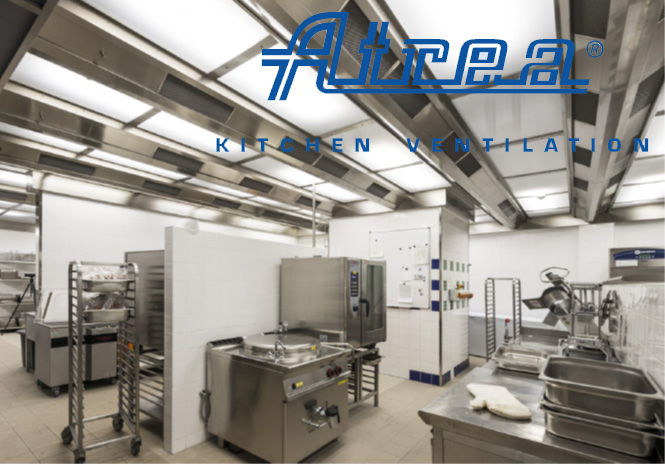
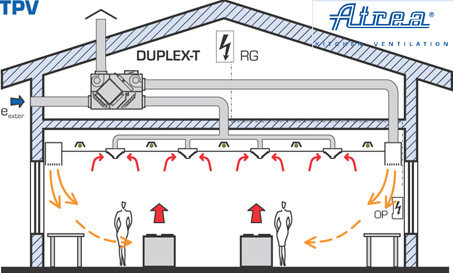
Full-area exhaust systems - air is removed from the entire area of the room through ventilated and air-conditioned ceilings of open or closed type.
Currently, ventilated and air-conditioned ceilings are increasingly used in kitchens of all types and sizes. One of the reasons is their price - very attractive, which is not much different from the price of a system with an exhaust hood. As a result, an increasing number of customers choose this ventilation system.
The main advantages of an exhaust system throughout the entire area of the room:
Original appearance of the kitchen interior.
Universal solution - the location of the equipment can be changed.
Easy capture of large amounts of steam and exhaust air.
Closed version - exhaust air is removed from the kitchen through grease filters located in closed channels. The advantage of this solution is the perfect separation of structural surfaces in the closed space of the kitchen for the removal of contaminated air.
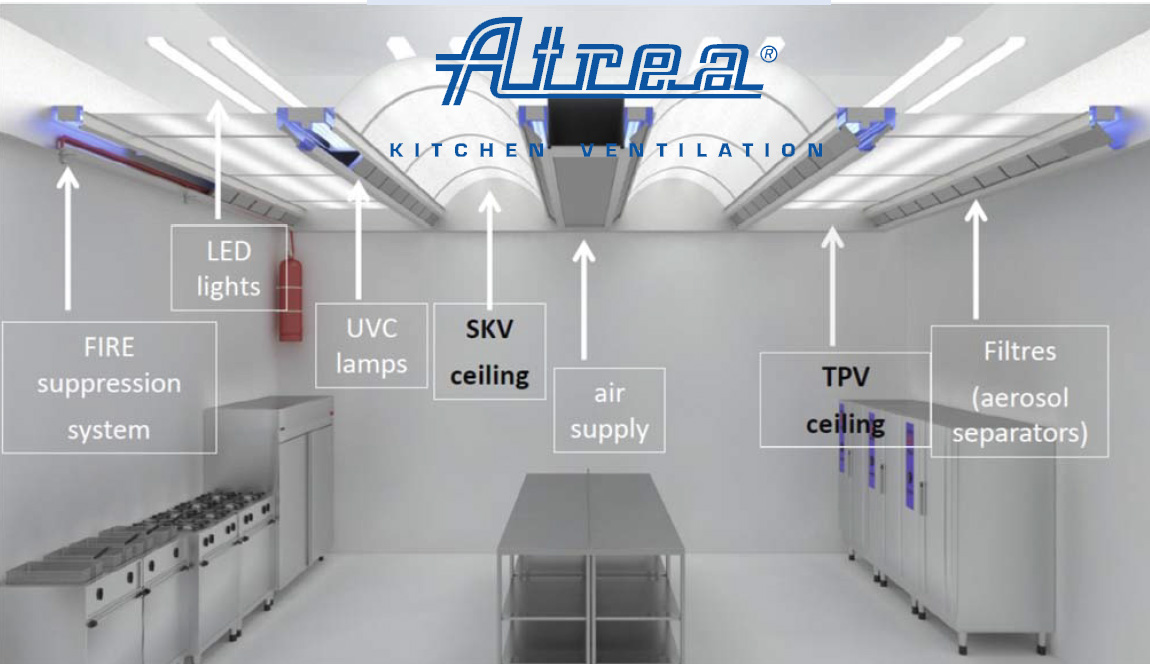
Suspended ceiling:
Meets the highest requirements not only in terms of design, but also in terms of hygiene.
Protects the ceiling structure from the effects of heat and humidity.
Air treatment:
Extraction and purification of polluted air throughout the kitchen area.
Supply of fresh prepared air after the recuperator from the "ATREA" ventilation unit.
There is no need to purchase more expensive ventilation equipment with built-in grease filters.
Kitchen lighting:
High-quality uniform lighting of the entire room.
LED lamps with low energy consumption.
Advantages of ventilated and air-conditioned ceilings from ATREA:
Can be used for kitchens of all sizes and types.
5 year warranty.
Investment is comparable to systems with hoods.
The closed hood system meets the strictest food hygiene requirements.
The closed system fully protects built-in lighting fixtures, ceiling structures and other communications.
Optimal hood over the entire area of the facility, which guarantees 100% removal of odors and polluted air.
This design is suitable for both industrial and public kitchens (canteens).
Guaranteed 500 lux of light intensity on the work surface with minimal fluctuation.
Even air flow through large diameter openings.
A pleasant and comfortable air environment for personnel.
If the location of the kitchen equipment changes, there is no need to modify the ventilated ceilings or the ventilation and air conditioning system.
Quick, easy and cheap cleaning of external and internal surfaces thanks to the use of stainless steel and polycarbonate materials.
Maintenance consists only of cleaning the grease filters in the dishwasher 4-6 times a year, depending on the intensity of use.
The purchase price is 30-50% lower than similar manufacturers.
Experience in implementing over 100 projects in European countries.
Additional built-in UV-C filtration:
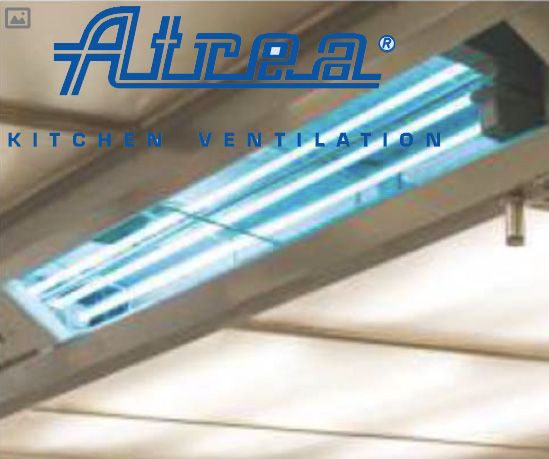
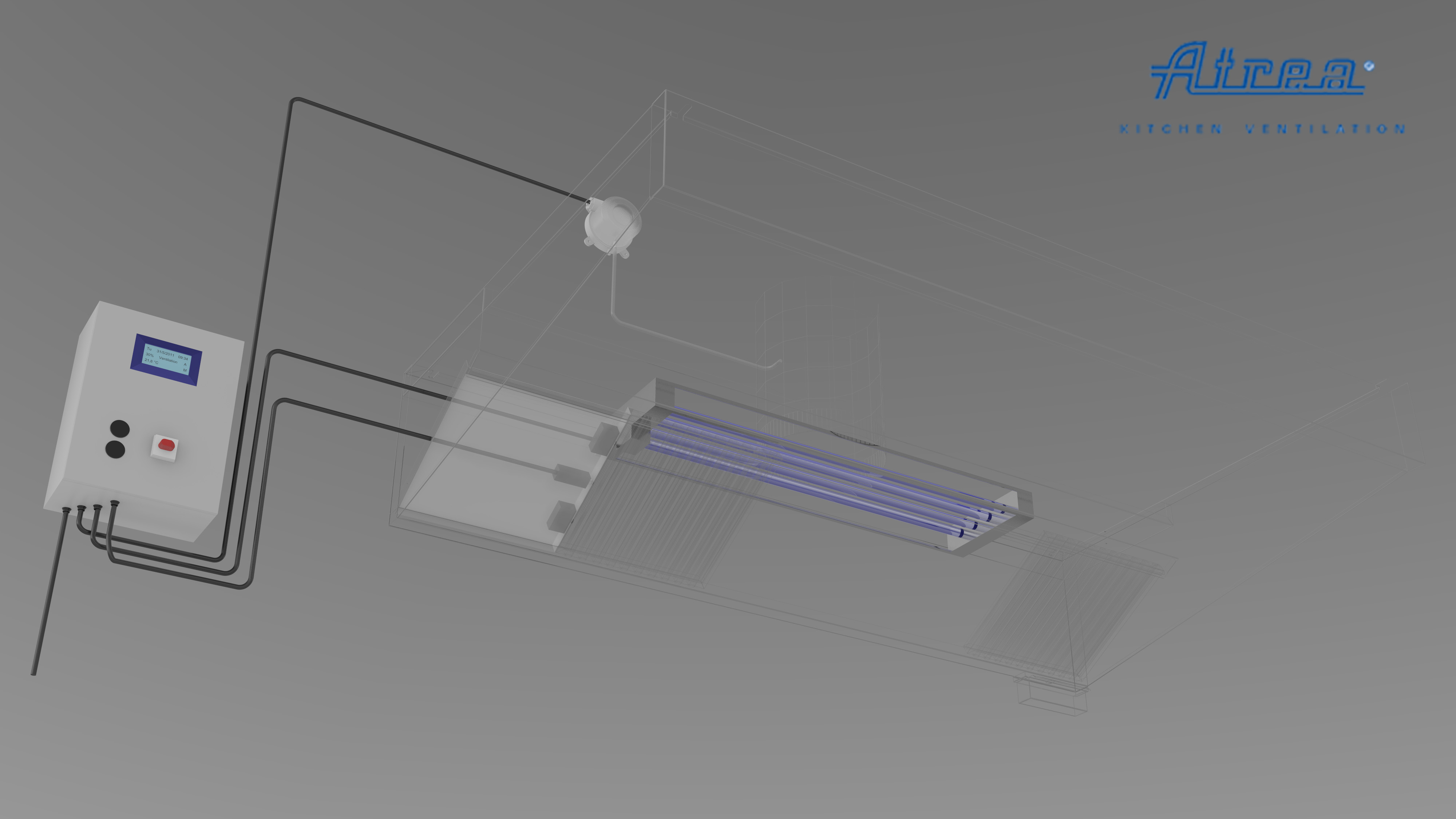
The main filtration is considered to be mechanical filtration with an efficiency of 80%, the rest is eliminated using a UV-C filtration system with an efficiency of 99%. As a result of this process, the exhaust air is cleaned of all grease. The main advantages are the elimination of the possibility of fire, a significant reduction in maintenance and cleaning costs, an extension of the service life and, most importantly, the elimination of the exhaust air of an odor that is unpleasant for others.